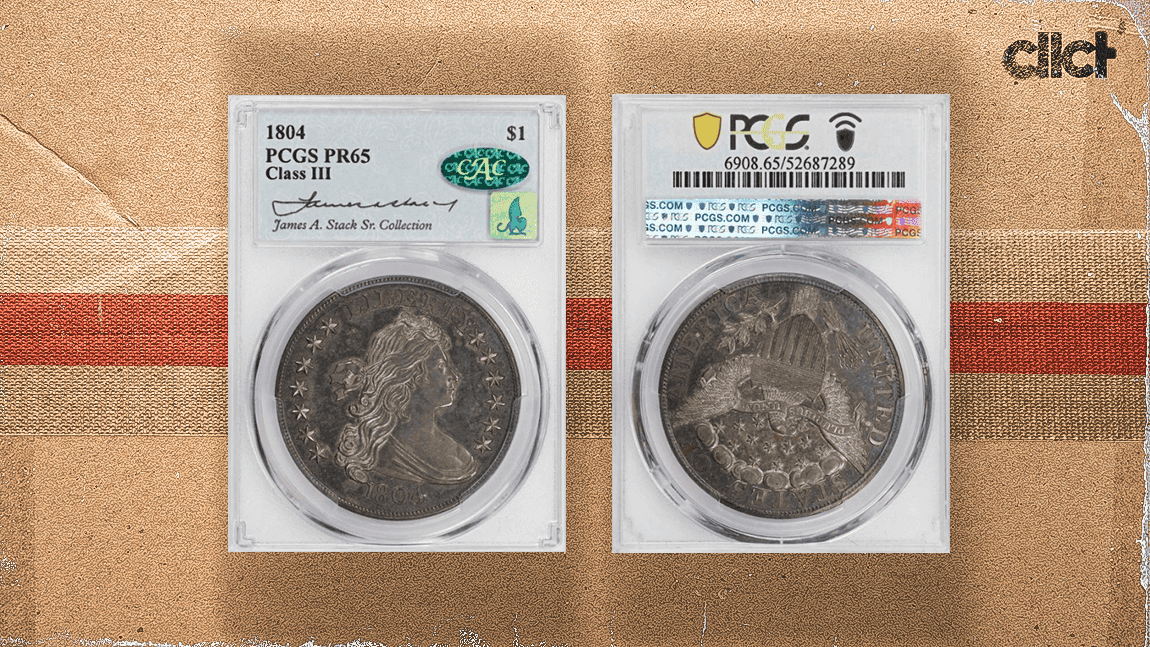
In 1834, President Andrew Jackson ordered “a set of gold and silver coins of the U.S. neatly arranged in a Morocco case” to gift to various Asian heads of state.
His staff checked government records and found the last time silver dollars were produced was 30 years prior, in 1804, deciding this would be the date on the new coins. However, there were actually no dollars dated 1804 struck during that year, making these the very first, and inadvertently creating one of the most valuable numismatic rarities in the long history of the hobby.
Eventually, it resulted in Tuesday’s sale of an 1804 silver dollar for $6 million at Stack’s Bowers.
Of those coins gifted to leaders, eight are believed to exist today, included the one gifted to the Sultan of Muscat, which sold for $7.68 million in August 2021.
The 1804 dollar has been dubbed the “King of American Coins.”
Shortly after the original 1804 dollar’s creation in 1837, coin collectors began clamoring for them. The result? Employees of the mint began striking additional copies (identified today as Class II and Class III; the $6 million coin is Class III) and selling them to local collectors.
A letter included in the auction lot from 1861 on behalf of the Boston Numismatic Society accused the Mint of having struck additional 1804 dollar coins and selling two for $75 each.
The coin that sold Tuesday belonged to the collection of James A. Stack, one of the most prominent coin collectors in history, where it sat for 75 years. It is unclear from whom Stack acquired the coin originally.
Want more stories like this? Subscribe to the cllct newsletter and follow cllct on X and Instagram.
Will Stern is a reporter and editor for cllct, the premier company for collectible culture.