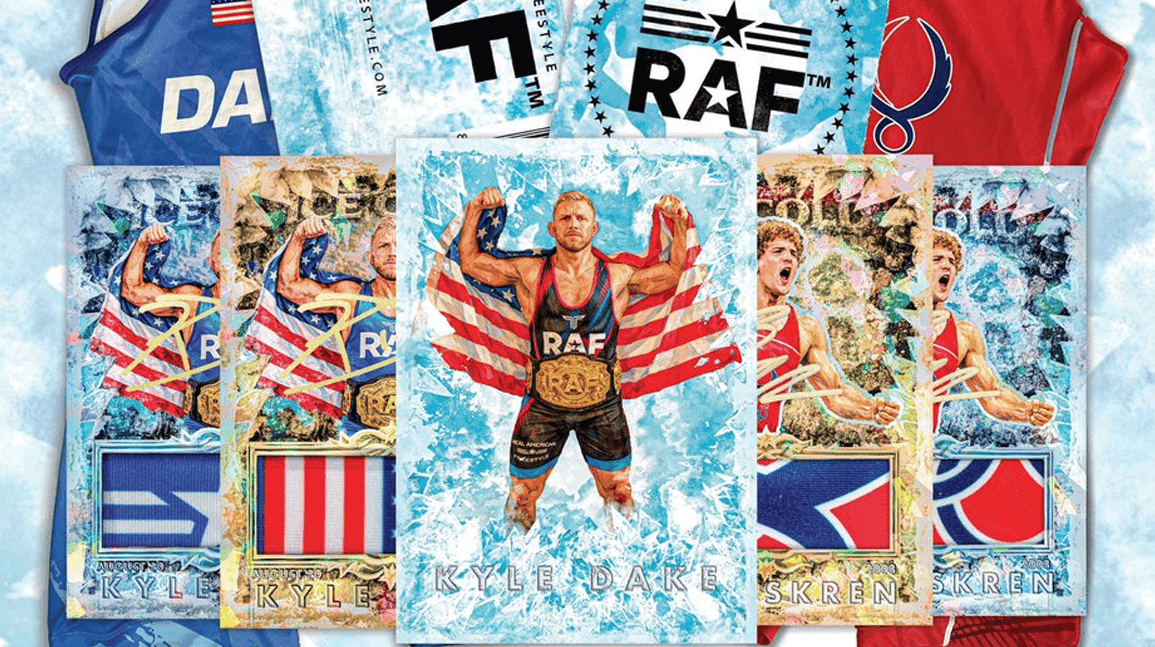
Real American Freestyle (RAF) Wrestling began like many stories, with a father and a son.
Chad Bronstein, the founder and CEO of RAF, has wrestled throughout his life and now watches his 9-year-old son Chase wrestle. But unlike basketball or football or essentially any other mainstream sport, his son couldn’t immerse himself in wrestling culture in the same way fans of those other sports could. Matches on television were basically non-existent, and collectibles were scarce at best.
This isn’t the wrestling you watch on WWE. This is the wrestling that you can only watch nationally every four years in the Olympics or when the NCAA Championships are on.
“There's never been a professional freestyle wrestling league,” Bronstein said. “You know, when you're younger, you're looking up to the Hulk (Hogan), but you're not looking up to the wrestlers that are professional athletes. ... And also there's never been a really good trading card business in the sport.”
“So I saw an opportunity.”
And Bronstein seized it, establishing a league centered around providing greater career opportunities for professional wrestlers, pushing the sport into the daily sport zeitgeist and most importantly creating an organization whose crux is to bring the closest fan-to-athlete relationship possible.
At its core, the mission of RAF is to bring the wrestling community together. That is done, of course, through matches, but also fan engagement.
In the last seven days RAF completed its sixth flagship event and launched its second set of trading cards.
“This is a company that launched in the live sporting event space with consumer products essentially right out of the gate,” said Jeremy Padawer, a toy industry executive and entrepreneur who also is a fervent wrestling collector. “That is, that is not a low bar to accomplish and to have a fandom that's already engaged.”
Given Padawer’s expertise in consumer products,as well as his passion for wrestling, both freestyle and scripted wrestling like the WWE, Bronstein sought his advice on trading cards before the league even launched, knowing collectibles would be central to the company’s business.
"The comprehensive vision,” Padawer said, “I thought was remarkable.”
“If you think about the major sports, they spent decades developing an infrastructure that allowed them to, A, be in the consumer products business and B have sort of the history of athletes that would make it viable.”
The consumer had to buy into both the league’s legitimacy and viability as well as the athletes themselves. RAF features many high-profile UFC fighters who now have an outlet to return to their wrestling roots, such as Henry Cejudo, Colby Covington and Aljamain Sterling.
And RAF funded the creation of the cards, despite what others instructed them to do.
“Everyone told us, ‘Hey, we're not ready for it yet. We're not ready for it,’” Bronstein said. “We put the money up ourselves to do it. ... and now we have a real business from it."
To make the cards, the RAF team sought out Jordan Spector, a Philadelphia-based artist who has recently made headlines for his work in relic cards, launching collections with athletes like Eagles legend Brandon Graham.
“I was excited in the fact that they saw the value proposition with that of starting to do their cards from the jump and really setting the tone for that ecosystem,” Spector said. “And be a part of what they're building.”
The first launch, which came in October, featured 2,000 cards and sold out almost instantly. The latest launch, the Icy Hot Edition, features 25 athletes and includes the league’s first-ever relic cards.
“I always knew that it was a big enough industry. If we did it ourselves, we could prove that success,” Bronstein said. “A lot of people in the trading card world told us ‘we got this, we got that,’ in the sense of we weren't going to be their focus. So we took a gamble and started ourselves.”
Where the hobby truly comes alive at RAF is in the fan zones. The league’s second event was held at Penn State on Oct. 25, which coincided with the launch of the first set of trading cards. That’s where RAF launched the fan zone, an area by the mat where kids could gather to meet the athletes and get their cards signed.
At RAF 5 in Miami, there were over 1,000 kids in the fan zone, Bronstein said.
The concept of the fan zone was inspired by Bronstein’s work with Hogan. The two worked together to create Real American Beer, and when they would be on the road together, fans attending meet and greets with Hogan would always bring items to be signed.
“We just wanted to create the ability for that to happen, Bronstein said. “So I think that the engagement is incredible.
And the experiences of touring with Hogan helped instruct the do’s and don'ts for the fan zone. But fans and wrestlers alike have loved the experience, Bronstein added.
“Wrestling is very humble. ... None of these athletes will leave (the fan zone).” Bronstein said. “If you post, ‘Hey Kyle Dake, can I send this to your house?’ They'll probably give you the address and he'll sign it.”
Wrestlers don’t have the overwhelming celebrity of other sports. But these trading cards allow their brands to grow and develop and their legacies to live on, Bronstein said.
“I think that this world of memorabilia allows that to continue. It really does,” Bronstein said. “We're generating that relationship with the professional, who's an unbelievable athlete, and then the young kids that are trying to get to know and become them.”
Other combat sports followed taken suit.
Padawer expects RAF only to continue to flourish. Frankly, he and wrestling fans have been waiting their whole lives for this type of organization.
“Wrestling is in every high school. It's in practically every school across the country,” Padawer said. “And so the fact that this didn't exist, I think that this is going to be the fastest growing sports league, not just in the United States, but the world. Therefore, you know, these early sets of collectibles might take on a real different kind of nature as a result.”
Sunday evening, the day following RAF 6, Cayden Henschel posted his first card to his Instagram, calling it a “dream come true” to have his own RAF card.
Along with the many big-name UFC fighters who are competing in RAF and have had plenty of their own previous memorabilia opportunities, there are, of course, strictly traditional professional wrestlers who are now able to see themselves on a trading card for the first time. And seeing their reactions never gets old.
"A lot of these guys have not had their flowers for their respective sport, because wrestling has not been made popular until now,” Spector said. “They've got true fan bases now."
Matt Liberman is a reporter and video producer for cllct, the premier company for collectible culture.